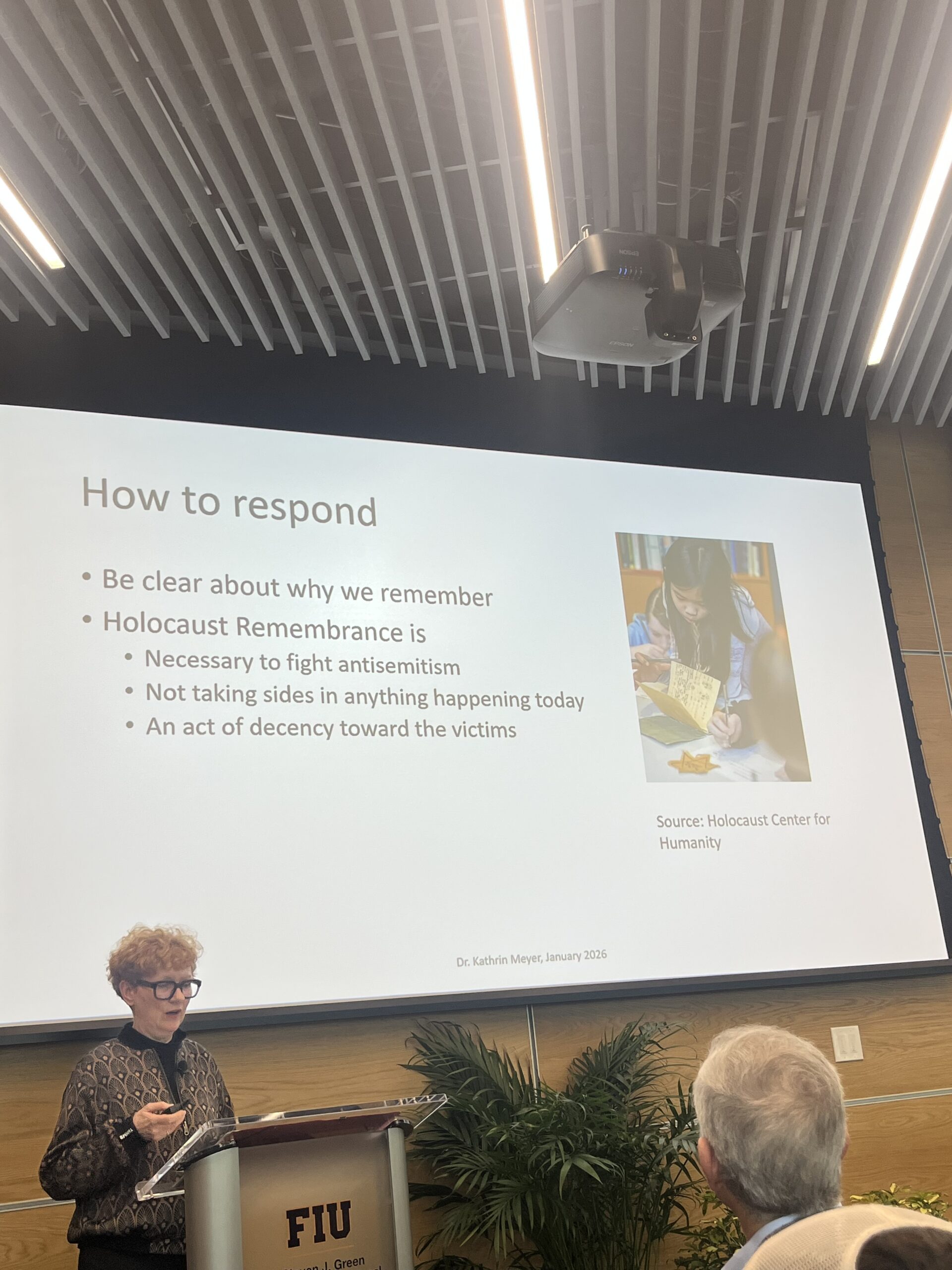
An assault on truth, a threat to Jews and democracy
by Dr. Kathrin Meyer
As we approach International Holocaust Remembrance Day, January 27, 81 years after the liberation of Auschwitz, the loss of survivors and collective memory has taken its toll. Numerous polls have shown a lack of awareness about the Nazi genocide, particularly among young people. Equally disturbing is the widespread distortion of the Holocaust, a virus that has infected many parts of society and that is not just an insult to the victims and the survivors of this unprecedented genocide, but a stepping stone to contemporary antisemitism and a threat to our democratic societies.
Holocaust distortion takes many forms. It is riddled with conspiracy myths and antisemitic stereotypes, galvanizing extremists from the right and the left.
Unlike Holocaust denial, which rejects the fact of Nazi genocide killing six million Jews, distortion downplays Nazi crimes, blames Jews for their own genocide and trivializes the Holocaust by comparing it to contemporary issues. And, most insidious, to equate the victims of the Holocaust with the perpetrators, Jews with Nazis, a frequent and obscene occurrence often used to delegitimize the existence of the State of Israel. This kind of distortion, which has recently become known as Holocaust inversion, legitimizes attacks on Jews around the world and therefore any form of antisemitism.
Holocaust distortion is not new. Distortion started already with the Holocaust, by the Nazis themselves. By talking about “Sonderbehandlung” (special treatment) or the “Endlösung” (final solution) instead of what it was: murder and planned total annihilation of the Jewish people.
As a German citizen who came of age in the 1970s and 1980s, I was among the first who learned about the Holocaust in school. German society just started to discuss the issues of their past. I heard very little about the suffering of Jews, nothing about the collaboration of the locals, but much about Germans as victims of the war, the result of bombings and displacement. It took the German society decades, far too long, to start facing their past, to start recognizing that Nazi crimes were not only committed by Hitler and his cronies, but that it was the overall society that supported the Nazi ideology and benefitted from it.
Why should we be concerned about Holocaust distortion? For one thing, it minimizes the enormity of the crimes of the Nazis, the systematic and deliberate genocide of six million Jews. Out of respect for the victims, historical accuracy and understanding, such comparisons must never be allowed to go unchallenged.
For another, it legitimizes antisemitism. It is the victimhood of Jews during the Holocaust and the common understanding of the horrific crimes committed by Nazi Germany and its collaborators that extremist groups, right and left want to question. By denying the victimhood from Jews, antisemitism is justified. This also conveniently releases societies from their responsibility to face their own past, the wrong doings committed against the local Jewish communities, such as collaboration during the Nazi period and sanctifies the demand end remembering the Holocaust.
On a broader level, Holocaust distortion is a threat to democracy. In my many years of studying this phenomenon, it is hard to find a single radical, anti-democratic, nationalistic, group ideology that does not have a distorted view of the Holocaust. Normalizing disinformation adds to growing concerns of extremism moving from the margins to the mainstream. It desensitizes people to hate speech and weakens support for human rights norms and institutions – law, universities, schools – that are based on historical truths and accuracy.
To counter the danger of Holocaust distortion, the most effective approach is education. Holocaust education focuses on historical accuracy, builds critical thinking skills that enable teachers and students to recognize antisemitic conspiracy theories and stereotypes, to reject trivialization of the Holocaust and ill-suited comparisons to contemporary events.
It is essential to provide teachers with skills to teach the Holocaust, recognize and reject the distortions that are flooding social media. Educartors play an essential role is this effort. They are on the front lines of confronting disinformation. And to bring the truth and the lessons of the Holocaust into their schools and classrooms. And the Olga Lengyel Institute, whose board I joined last year, is in the forefront of this cause, with Holocaust education programs for teachers across the US, in fifteen European countries and most recently Mexico.
The Holocaust could only happen because the values of human dignity of all, democratic principles, and the rule of law were destroyed. It happened mainly because of the indifference of mainstream societies all over Europe. It happened because the warning signs were not taken seriously.
By teaching about the Holocaust to the next generation, by remembering the victims, we contribute to the future of our societies. We allow for the opportunity to learn from the past. And we contribute to the promise that we were not able to keep but that we should never give up striving for: Never Again.
Dr. Meyer is one of the leading experts on Holocaust denial, distortion and antisemitism. From 2008-2025 she served as Secretary-General of the International Holocaust Remembrance Alliance. She joined the TOLI Board of Trustees in June, 2025.