
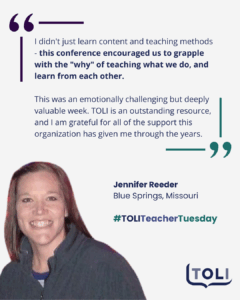
After twenty-four years in the classroom, Jennifer Reeder still walks into her high school each day with a sense of urgency – and hope. Teaching eleventh- and twelfth-grade students, she knows her time with them is brief, but the responsibility is immense. As a dual-credit U.S. History teacher and the instructor of a semester-long Holocaust elective, Jennifer has dedicated her career to ensuring that history is not reduced to dates and statistics, but understood as lived human experience.
Jennifer’s Holocaust course is intentionally designed to unfold slowly and thoughtfully across the semester. Beginning with identity and social responsibility, she invites students to examine who they are and how communities shape belonging. From there, she grounds them in an understanding of Judaism – its beliefs, traditions, and history – along with the long roots of antisemitism. As the course progresses through the aftermath of World War I, the rise of Hitler, the ghetto system, and the machinery of mass murder, Jennifer carefully centers the voices of victims and survivors. Testimony, literature, artwork, and primary sources are not supplemental materials in her classroom; they are the heart of the learning.
For Jennifer, teaching the Holocaust is inseparable from teaching civic responsibility. She consistently asks her students to consider whose stories are being told and whose are missing. In both her Holocaust elective and her U.S. History classes, she pushes students to connect personally with the past – to recognize individuals rather than abstractions. Her goal is not only historical understanding, but moral clarity: helping young people learn how prejudice begins, how it spreads, and how ordinary choices can either reinforce injustice or interrupt it.
This commitment was profoundly shaped in the summer of 2022, when Jennifer traveled to Poland as part of the Auschwitz Legacy Fellowship. Standing in Warsaw, Kraków, and at Auschwitz itself, she felt the weight of history in a way that could not be replicated in a textbook. That experience marked a turning point. When she returned home, she successfully advocated for a new semester-long Holocaust course, determined to bring deeper, more sustained Holocaust education to her students.
The following summer, Jennifer continued that journey at Yad Vashem in Israel through the Advanced Teachers Seminar. There, she gained new pedagogical tools, scholarly insight, and a renewed sense of purpose. Since launching her Holocaust elective in fall 2023, she has remained deeply engaged in professional learning communities, always seeking better ways to teach responsibly and meaningfully.
Jennifer teaches at a time when misinformation spreads faster than historical understanding. One of her greatest challenges is helping students navigate social media narratives, particularly around antisemitism and the Israeli–Palestinian conflict. She regularly encounters students who arrive in class armed with headlines or viral videos taken at face value. Rather than shutting down conversation, Jennifer meets these moments with patience and rigor – teaching students to evaluate sources, seek multiple perspectives, and understand historical context before drawing conclusions. She sees this work as essential preparation for democratic citizenship.
Despite the challenges, Jennifer is hopeful. She believes deeply in her students’ capacity for empathy and moral growth. She sees young people who want to help others but are often trapped in polarized “us versus them” thinking. By teaching the consequences of indifference and the power of standing up for one’s neighbors, Jennifer equips her students to choose a different path.
As she enters the final decade of her teaching career, Jennifer feels more energized than ever. Her experiences with programs such as the Auschwitz Legacy Fellowship, Yad Vashem, the Jewish Foundation for the Righteous Summer Institute, Teaching with Testimony, and – of course – TOLI have reignited her passion and sharpened her sense of purpose. She now seeks not only to deepen her own practice, but to collaborate with fellow educators—to turn classroom inquiry into informed action.
Ultimately, Jennifer Reeder teaches the Holocaust not because it is history that must be remembered, but because it is a warning and a call. In her classroom, remembrance becomes responsibility, learning becomes empathy, and history becomes a guide for how her students might shape a more just and humane future.
Jennifer Reeder: Where History Becomes Human