
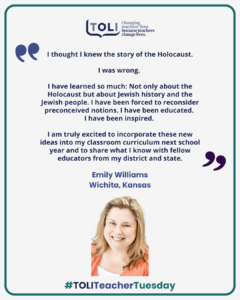
For Emily Williams, teaching history is about more than understanding what happened in the past. It is about helping students understand how the choices people make shape the present, and how they can use that knowledge to make better choices themselves.
A veteran educator entering her 25th year in the classroom, Emily teaches U.S. History, AP U.S. History, and College U.S. History at a large suburban public high school in Kansas. She also serves as an adjunct professor at WSU Tech and has held leadership roles with the Kansas Council for History Education, including serving as its President. In 2018, she was named KCHE Secondary Teacher of the Year.
This summer, Emily joined our seminar in Virginia, “Exploring Humanity Through Hard History,” bringing with her decades of experience teaching some of the most challenging chapters of American history, and a deep commitment to helping students engage with difficult questions honestly and thoughtfully.
“When you know better, you should do better.”
That phrase is one that Emily’s students hear throughout the school year. For Emily, the study of the Holocaust, civil rights, and human rights provides an opportunity to explore what that principle means in practice.
“When I teach about the Holocaust, civil rights, and human rights in U.S. History, I try to create a balance between the content being taught and opportunities for students to consider and reflect on the impact of these events and how they continue to shape the world we live in,” she explains.
In her Holocaust unit, Emily begins by establishing the historical context: the rise of Nazi Germany, antisemitism, and the international response. Students then encounter individual experiences through primary sources, survivor testimony, and visual materials. They examine the roles of perpetrators, bystanders, and upstanders while considering questions of ethical and civic responsibility.
Her approach to civil rights education is equally personal.
Emily was born in Greenwood, Mississippi, just 10 miles from Money, where Emmett Till was murdered. Both her maternal and paternal families are from Greenwood, and she is able to share firsthand accounts and family stories about the aftermath of Till’s murder and the events that followed.
She also draws on experiences that have shaped her own understanding of history. Emily has met Elizabeth Eckford of the Little Rock Nine and several people connected to the Dockum Drugstore sit-in in Wichita. These encounters help her show students that history is not simply a story of famous figures.
“Students often find their interest piqued as they realize that these were ordinary people just like them,” she says. “They then begin to wrestle with questions such as: How did those ordinary people impact change, and what makes a movement successful?”
For Emily, this connection between history and the choices students make today is central to her teaching.
“These are not just moments from the past—they are real examples of how people’s decisions, both good and bad, have lasting consequences,” she says. “I want my students to understand that history is not just something that happened, but something that continues to shape the world they live in and the responsibilities they carry as citizens.”
Her classroom is a place where students are encouraged to ask difficult questions about fairness, justice, human dignity, and responsibility. Emily believes that creating space for honest disagreement and thoughtful discussion is essential to meaningful learning.
That goal is particularly important in the diverse school community she serves. Her high school is one of the largest in Kansas, with nearly 2,200 students. Approximately 40 percent of students identify as minorities and nearly half are economically disadvantaged. Despite challenges including student engagement, gaps in background knowledge, the influence of social media on how students process information, budget cuts, and large class sizes, Emily has seen growing demand for advanced history courses.
For the coming school year, she will teach two sections of AP U.S. History and four sections of College U.S. History: the highest enrollment for these courses her school has seen.
“Students clearly want to be challenged,” she says. “My goal is to create a classroom environment where everyone feels respected and willing to engage in thoughtful, honest discussions, even when opinions differ.”
Emily came to TOLI’s Virginia seminar with a desire to continue growing as an educator. After decades in the classroom, she remains committed to learning new approaches to teaching difficult subjects with accuracy, sensitivity, and purpose.
“I am always looking for better ways to present them with accuracy, sensitivity, and purpose,” she says of Holocaust and human rights education. “I want to continue strengthening my ability to guide students through difficult conversations while helping them think critically and empathetically about the past and its connection to the present.”
The seminar offered an opportunity to add new resources, perspectives, and strategies to the extensive experience she already brings to her classroom.
For Emily, professional growth is inseparable from collaboration. Her work with the Kansas Council for History Education, the Kansas State Department of Education Teacher Leaders group, and the development of Kansas History, Government, and Social Studies standards reflects her commitment not only to teaching history, but to continually rethinking how it can be taught effectively.
“Collaborating, networking, learning and growing help to maintain the momentum and relevance needed to thrive in an educational environment,” she says.
That philosophy also captures what she hopes to give her students: the confidence to learn from the past, question what they encounter, and recognize their own capacity to make a difference.
“Justice is not finite – it is something we must continually pursue,” Emily says. “That responsibility belongs to each of us.”
And for Emily, that pursuit begins in the classroom, with the belief: When we know better, we can do better.

Emily Williams: “When you know better, you should do better.”